
A seller once told me she’d sell her rental to her nephew for a dollar and “just take the loss on her taxes.” She was wrong about the loss. One wrong assumption would have cost her thousands. Selling a house below market value isn’t illegal, isn’t rare, and isn’t automatically a tax disaster. But the rules shift depending on who’s buying, what you paid originally, and whether you lived in the house. Let’s walk through what the IRS cares about and what it ignores.
What Is a Below Market Value Home Sale?
Price your house wrong on paper and you can hand the IRS a gift tax return you never intended to file. The real risk here isn’t jail, not an audit knock on the door, just a transaction recharacterized into something you didn’t plan for.
A below market value sale happens when the price you accept sits meaningfully under what the property would fetch from an unrelated buyer in an open sale. So it’s worth knowing how fair market value actually gets defined. Fair market value is what a willing buyer pays a willing seller when neither one is under pressure and both know the facts.
So what counts as “meaningfully under”? There’s no bright line in the tax code. A house that sells for a few percent under an appraisal after sixty days of silence is just a market outcome. But a house that transfers to your daughter for half its appraised worth is a different animal entirely.
These numbers set the tone. In October 2026, the National Association of Realtors put the median existing-home price at $416,700, with homes sitting a median of 35 days on the market, up from 33 in September. Redfin measured a national median sale price of $388,634 that same month, down 0.35% from a year earlier. Those two numbers measure different pools of homes, and the gap between them shows how slippery “market value” gets even before family enters the picture.
A couple of years ago I bought a house in Boise from a family whose dad got transferred with five weeks’ notice. They took a price under what a six-month listing might have produced because the moving truck was already scheduled for a Thursday. Nobody at the IRS blinked at that sale, because they were strangers to me and the discount bought them certainty.
When Does It Make Sense to Sell a House Below Market Value?
A discount isn’t a loss if the house was never worth retail in its current condition. Deferred maintenance, a failing roof, a tenant who won’t leave, an old foundation problem: these knock real dollars off what any buyer will pay. The “market value” number in your head may already be stale.
Family transfers top the list of deliberate discounts. Parents sell to adult children at a price the kid can finance.
Closing fast is the other big driver. With inventory at 1.59 million homes and a 5.1-month supply in October 2026, buyers have room to negotiate that they didn’t have two years ago. Sellers facing a job start date, a divorce decree, or a mortgage they can no longer carry often trade dollars for weeks, and that trade is rational.
No. I’ve watched sellers accept 70 cents on the dollar when a modest cleanout and three more weeks would have gotten them 88. Run the arithmetic before you run from the house.
You do your own math on inherited property. When you inherit, your basis generally resets to the value at the date of death, so a quick sale near that figure often produces little or no taxable gain.
Selling for less also makes sense when carrying costs are eating you alive. Taxes, insurance, utilities, and a mortgage payment on an empty house add up every single month, so that firm closing date starts looking better than top dollar. Teams like Kentucky Sell Now exist for exactly these situations, where a seller needs a firm closing date more than a record price.
How Does the Irs View a Below Market Value Sale?
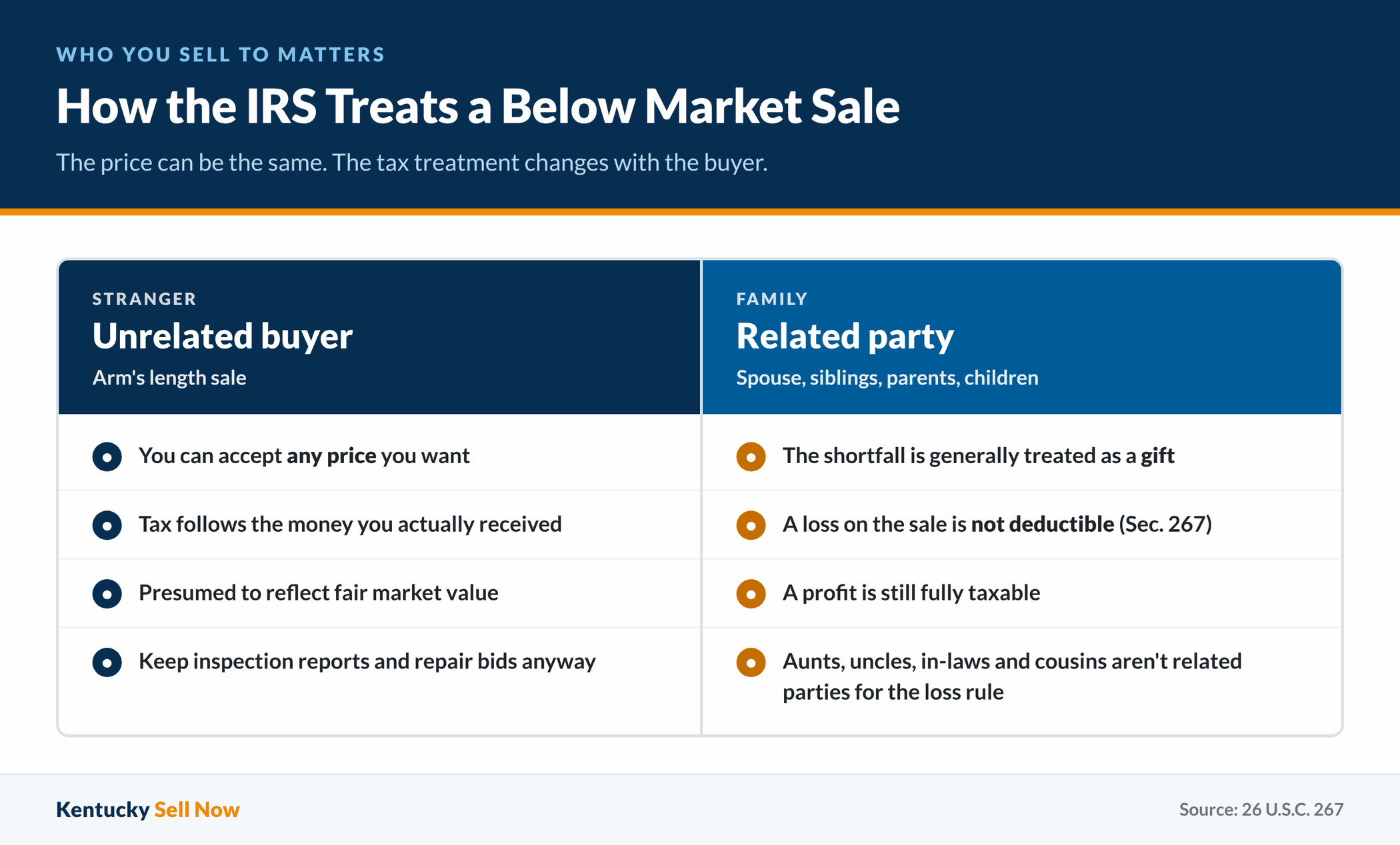
And that brings us to the agency’s actual position, which surprises people in both directions. The IRS doesn’t require you to sell at fair market value. You can accept any price you want from an unrelated buyer, and the tax consequences follow the money you really received.
Related parties get different treatment. Sell to a family member for less than fair market value and the IRS generally treats the shortfall as a gift from you to them.
Who counts as related? Under the related-party rules, family includes your spouse, siblings (whole or half blood), ancestors, and lineal descendants, while aunts, uncles, in-laws, and cousins are not treated as related parties for the loss-disallowance provision.
That loss rule stings. Section 267(a)(1) disallows any deduction for a loss on a sale between related parties. This means a parent who sells property with a $100,000 basis to a child for $60,000 gets no deduction for the $40,000 difference. You can read the statute itself through Cornell’s U.S. Code library or ask your CPA to walk the rule with you.
A partial rescue is built in. The buyer may be able to use that disallowed loss later to reduce gain when they sell the property to someone unrelated. But it never benefits the original seller. If the related buyer later sells at a loss, that disallowed amount just disappears for good.
Sell to your brother at a profit and that profit is fully taxable, exactly as it would be with a stranger.
Does Selling a House Below Market Value Affect Your Taxes?
Picture a widow who bought in 1998 for $82,000 and transfers the house to her son for $150,000 when a neighbor’s comparable just closed near $300,000. On paper she took a discount, but her return still shows a gain of roughly $68,000 before adjustments.
Your tax bill tracks what you actually collected, minus your adjusted cost basis and selling costs. A discount lowers your proceeds, so it usually lowers your taxable gain too, but selling for less never creates a deduction for the money you left on the table.
You should weigh basis more than price here. Your cost basis starts with what you paid, then climbs with capital improvements: the new roof, the finished basement, the addition.
Three separate tax questions ride on one underpriced transaction. There’s gain or loss on the sale itself.
Your rate is set by that answer. Short-term gains get taxed as ordinary income at your regular bracket, while long-term gains fall into the lower capital gains tax rates.
Rental and investment property owners carry an extra passenger: depreciation recapture. Every year of depreciation you deducted comes back as taxable income at sale, and a discounted price doesn’t erase it.
Capital Gains Tax on a Below Market Value Home Sale: How Is It Calculated?
Sell for less than the house is worth and the tax owed should be zero, right? Not necessarily, because it compares your sale price to your basis, and a seller who bought cheap decades ago can owe tax even after a steep discount.
Start with the sale price. Subtract your adjusted cost basis.
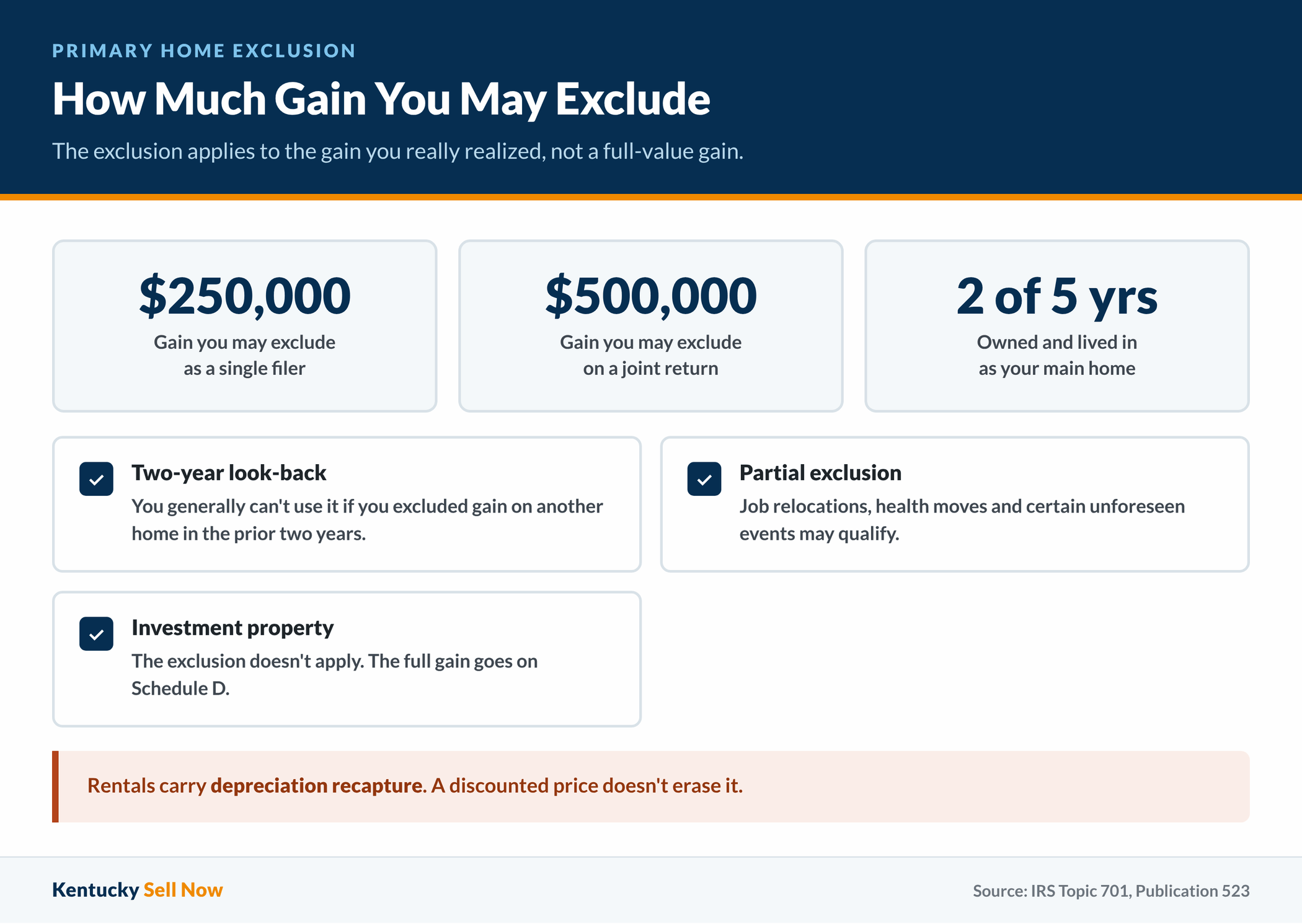
Primary residences get powerful relief. If you have a capital gain from selling your main home, you may exclude up to $250,000 of it, or up to $500,000 on a joint return with your spouse, according to the IRS at irs.gov. You just need to have owned and lived in the home as your main home for at least 2 of the last 5 years before the sale date.
That exclusion applies to the gain you really realized, not to some hypothetical gain at full value. So a long-time homeowner selling to a relative for less than it’s worth often walks away owing nothing in federal capital gains tax.
Watch the look-back rule. You generally can’t use the exclusion if you already excluded gain from another home sale during the two-year period before this one. Job relocations, health moves, and certain unforeseen events can qualify you for a partial exclusion instead, and the worksheets in IRS Publication 523 run those numbers for you.
The main home exclusion applies only to your residence, so an investment property sold for less reports its full gain on Schedule D.
Gift the discount to a relative and they inherit your basis for that portion, not a fresh one at the discounted price. Their eventual tax bill grows accordingly.
Can Selling Below Market Value to Family Trigger Gift Tax?
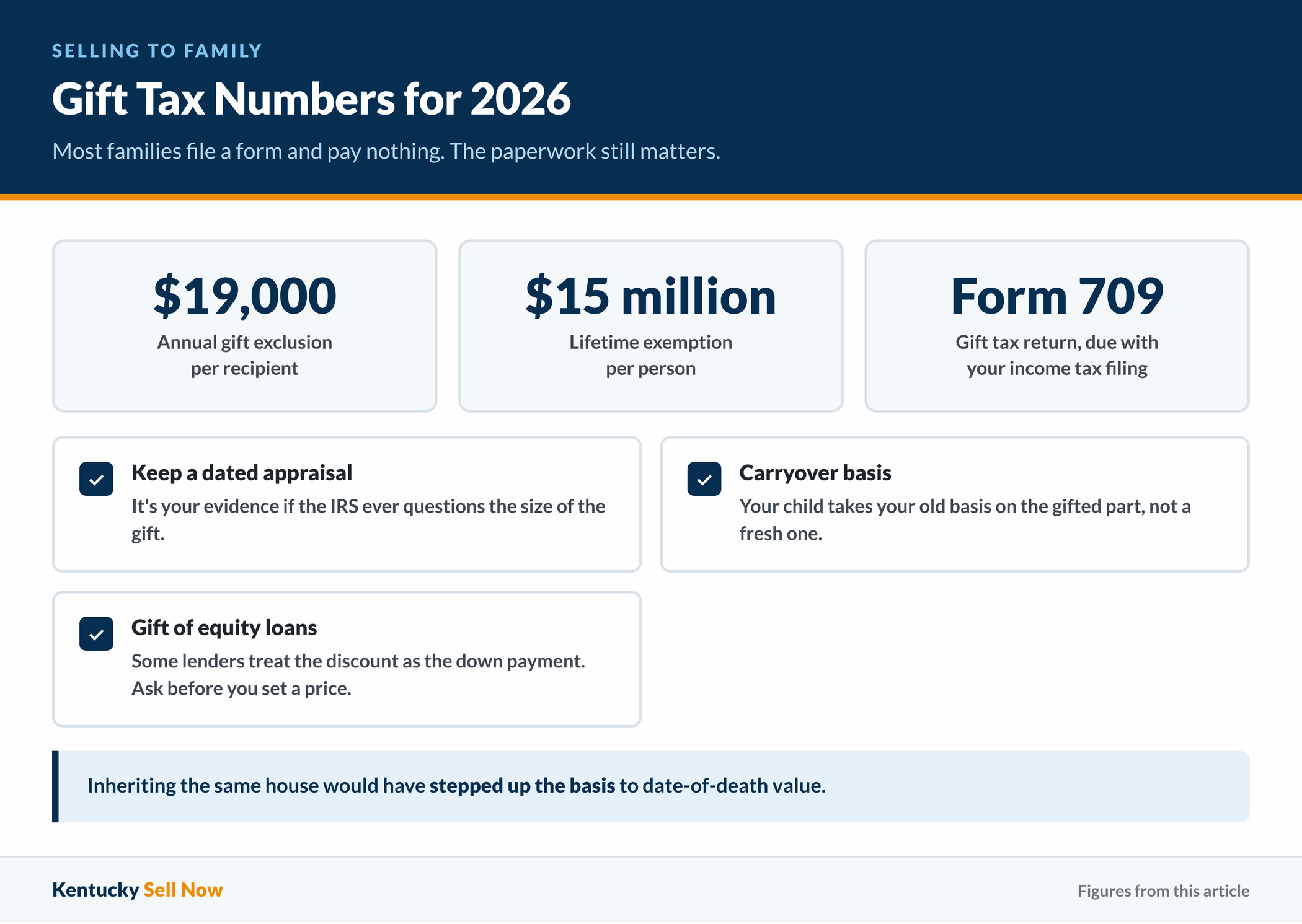
$19,000. That’s the per-recipient annual gift tax exclusion for 2026, unchanged from 2025 according to the IRS. Sell your daughter a house for far less than its fair market value and you’ve made a gift far past that line.
A donor generally owes gift tax only after using up the lifetime exemption, which stands at $15 million per person in 2026 under the One Big Beautiful Bill Act. Nearly every family doing this kind of transfer files a form and pays nothing.
The form is Form 709, due with your income tax filing the following spring.
Keep an appraisal. If the IRS ever questions the size of the gift, a dated professional valuation from the time of the transfer is your evidence, and reconstructing one years later is painful.
Here’s the part families underweight: carryover basis. Inheriting the same house instead would have stepped that basis up to date-of-death value. Selling a home for less than it’s worth to a child during your lifetime can quietly hand them a bigger future bill than doing nothing at all.
Many will finance a “gift of equity” purchase, treating the discount as the down payment, though documentation requirements are strict. Talk to the lender before you agree on a price, not after.
What Are the State Tax Implications of a Below Market Value Sale?
“Federal rules are the only ones that matter, since most states just copy them.” Not quite. State income tax treatment of capital gains varies widely, and a handful of states tax gains as ordinary income with no preferential rate at all. California is the common example, where capital gains ride at regular state income tax rates.
Several states tax deed transfers between close relatives at a reduced rate or exempt them, and plenty don’t. Your county recorder or clerk can tell you the current rate and whether a family exemption exists where the property sits.
Property tax reassessment is the sleeper issue. Some states reassess at the new sale price, which could lower the buyer’s bill after such a sale, and others reassess at full market value regardless of what the deed says. A few offer parent-to-child exclusions that preserve the old assessment, with applications and deadlines attached.
No. State rules stack on top of the federal result; they don’t replace it.
Six states still impose an inheritance tax, and some look back at transfers made within a certain window before death. A discounted transfer to a relative shortly before a death can get pulled back into that calculation depending on the state.
Deed preparation isn’t a place to cut corners. The stated consideration on a deed can affect transfer tax, future title work, and what the IRS sees if it ever reviews the transfer. A real estate attorney in your state should draft it, and local buyers such as Kentucky Sell Now typically coordinate with a closing attorney as a matter of course.
How to Avoid Tax Penalties When Selling Below Market Value
For years I told sellers the gift tax return was optional paperwork if no tax was owed. Wrong. The return starts the clock on the statute of limitations, and skipping it leaves the valuation open indefinitely.
Get an appraisal before closing, not after.
Document why the price is what it is. Photos of the failing systems, repair bids, inspection reports: this file turns a suspicious discount into a defensible one.
Report the sale even when you owe nothing. If you get a Form 1099-S from the closing, you must report the sale on your return even if the gain is excludable. Missing a 1099-S that the IRS already has is how quiet transactions turn loud.
Talk to a CPA before you sign anything, not in April. Pricing, timing, and whether to transfer the whole property or a partial interest all have different outcomes, and those decisions are nearly impossible to unwind afterward.
A couple in Dayton reached out after six years of chasing rent on a duplex they’d inherited and never wanted. They sold as-is, below what a renovated comp would have brought, and the discount was pure condition and exhaustion, nothing the IRS would ever call a gift.
If selling below market value to a stranger is what your situation calls for, keep the transaction clean and documented. Working with an established buyer such as Kentucky Sell Now gives you a paper trail that shows an arm’s length negotiation.

Frequently Asked Questions About Selling a House Below Market Value
Can I Sell My House to My Child for a Dollar?
You can, and the deed will record just fine. The IRS will treat nearly the entire fair market value as a gift from you to your child, which means a gift tax return and a bite out of your lifetime exemption. Your child also takes your old cost basis on the gifted portion, so a sale decades later could produce a much larger taxable gain than anyone expected.
Do I Owe Capital Gains Tax If I Sell Below Market Value?
Possibly, yes. Tax is calculated on what you received minus your adjusted basis, so a seller who bought cheap long ago can still show a profit even after a deep discount. If the house was your main home and you meet the ownership and residence requirements described above, the federal exclusion may wipe out the gain entirely.
Will the Irs Question a Below Market Value Sale to an Unrelated Buyer?
Rarely. Transactions between people with no family or business relationship are presumed to reflect fair market value, because neither side has a reason to hand the other free money. Keep your inspection reports and repair estimates anyway, since documentation costs nothing and answers questions before they’re asked.
Does Selling Below Market Value Reduce My Property Taxes?
That depends entirely on your state and county. Some jurisdictions reassess at the recorded sale price, others reassess at appraised market value no matter what the deed says, and a few freeze the old assessment for qualifying family transfers. Your county assessor’s office can tell you which approach applies to your property.
Can I Claim a Tax Loss by Selling Below Market Value to a Relative?
No. The related-party rule discussed earlier shuts that door completely, and routing the sale through a friend who resells to your relative doesn’t work either, since the statute reaches indirect transfers. If you genuinely sell at a loss to an unrelated buyer, the treatment depends on whether the property was a personal residence or an investment, and losses on a personal residence aren’t deductible in any case.
Should I Get an Appraisal for a Below Market Value Family Sale?
Yes, every time. The appraisal fixes the fair market value as of the transfer date, which determines the size of the gift and supports the figure you report. Trying to establish that value years later, after the market has moved and the house has changed, puts you in a much weaker spot.
If you’re weighing a below market value sale and you’re not sure what it means for your taxes, start with a CPA in your state, then figure out your timeline. And if you’d rather talk through what a straightforward as-is sale would look like for your property, we’re glad to have that conversation. No pressure, no obligation, just a real answer about your options.
Talk Through a Below Market Sale With Kentucky Sell Now
Thinking about selling for less to family, or to a buyer who can close on your timeline? Reach out to Kentucky Sell Now and we’ll walk through what an as-is cash offer would look like for your house. We’ll also tell you when a CPA should weigh in first. You can use the short form below to get started.