

A cleanout crew can empty a three-bedroom ranch in Shively over a long weekend. Deciding what’s trash takes the family eleven months. That gap, between how fast a dumpster fills and how slowly a person lets go, is the whole story of selling a hoarder house in Kentucky. I’ve bought houses across the Commonwealth for years now, from Portland in Louisville to little brick places off Nicholasville Road in Lexington. The packed ones are never really about stuff.
What Is a Hoarder House in Kentucky?
Roughly one in forty adults meets the clinical bar. A meta-analysis pooling eleven studies landed on 2.5 percent of the population living with hoarding disorder, and that share climbs with age. Apply that to Jefferson County alone and you’re looking at thousands of homes where the living room hasn’t been used as a living room in a decade.
Cluttered isn’t the same thing as hoarded. A hoarder house in Kentucky usually means blocked exits, unusable kitchens or bathrooms, and pathways cut through stacked belongings, so appraisers and insurers end up judging function over anything else. Can somebody cook in that kitchen? Does the back door open?
Industry crews rate severity on a one-through-five scale, and the jump from level three to level four is where cost explodes. Level three brings visible clutter outside the home. The higher tiers introduce real biohazard conditions. Animal waste, rodent activity, standing water in a basement off the Ohio River floodplain: those push a Kentucky property into specialty territory fast.
A family in Erlanger called me last year about their dad’s place. They’d rented it out twice after he moved to assisted living, and both tenants left early because the garage still held forty years of auto parts nobody would haul. They were done being accidental landlords and said so plainly on a Tuesday afternoon.
Weather matters more in this state than people credit. Our humid summers and freeze-thaw winters turn a packed, unventilated hoarder house into a mold incubator within a couple of seasons, because trapped moisture has nowhere to go. Paper absorbs moisture. Cardboard wicks it off concrete slabs. By the time a hoarder house like that gets opened up, the drywall behind the stacks often tells a worse story than the stacks themselves.
Why Do Owners Struggle Selling a Hoarder House in Kentucky?
So the stuff has to go before the sign goes up, except that’s precisely where everything stalls. Most families I meet aren’t lazy or disorganized. They’re stuck between siblings who want different things and a parent who’s still alive and still saying no.
Plenty of good Kentucky real estate agents will politely decline a listing they can’t photograph. No photos means no MLS traction, and a hoarder house that sits unphotographed sits forever.
Financing kills more of these deals than clutter does. A conventional or FHA lender sends an appraiser, that appraiser can’t access the mechanicals, and the loan dies in underwriting. Your buyer pool shrinks to cash and hard-money investors before you’ve even priced the place.
Then there’s disclosure. When a licensed agent is paid on the sale, Kentucky sellers must hand buyers a completed Seller’s Disclosure of Property Condition form under KRS 324.360. The form lists known defects in structure, systems, water, and other items. You can read the statute itself on the Kentucky Legislature’s site. The word that governs everything is “known.” The law doesn’t make you inspect or discover defects you’re genuinely unaware of, but you can’t claim ignorance of obvious conditions.
Here’s where owners of a hoarder house in Kentucky get into trouble: they assume covered-up damage is undiscovered damage. It isn’t, not once a buyer’s inspector pulls back a wall of boxes.
Shame does the rest of the work. I’ve sat at kitchen tables where an adult daughter apologized to me for twenty minutes before she’d unlock the door. Nobody needs to apologize to a buyer who’s walked through hundreds of these.
What Are the Risks of Owning a Hoarder House in Kentucky?
Leaving the house closed up and dealing with it next spring sounds reasonable. It’s the single most expensive decision I see families make. A vacant, packed Kentucky property deteriorates on a schedule nobody controls.
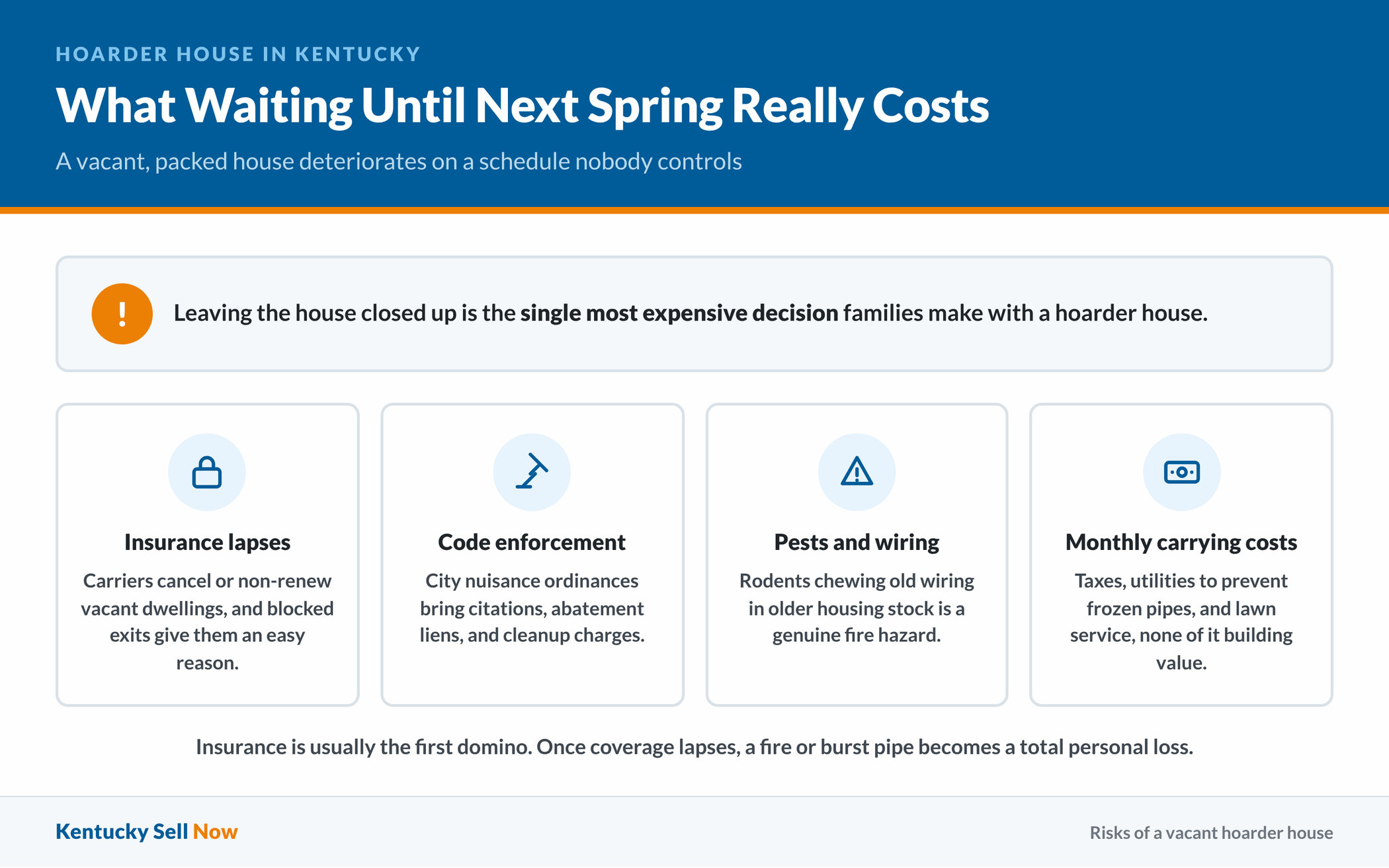
Insurance is the first domino. Carriers cancel or non-renew vacant dwellings, so a hoarder house with blocked egress gives them an easy reason. Once coverage lapses, a kitchen fire or a burst pipe in January becomes a total personal loss.
Code enforcement is the second. Kentucky cities run their own nuisance and property maintenance ordinances, so citations, abatement liens, and cleanup charges differ from Owensboro to Covington. Your city’s code enforcement office can tell you exactly what’s on file for your parcel and what the current penalty schedule looks like.
Pests don’t negotiate. Rodents chew wiring, roaches colonize wall voids, and in older Kentucky housing stock with knob-and-tube remnants, that combination is a genuine fire hazard, not a theoretical one.
Then you’ve got the money bleeding out monthly. Property taxes, utilities you’re keeping on to prevent frozen pipes, lawn service so the neighbors stop calling. None of that builds value in a hoarder house. It just slows the loss.
Health risk deserves plain language too. Ammonia from accumulated animal waste, airborne mold spores, and collapsing stacks injure people every year, so this isn’t a risk worth taking lightly. Two of the sellers I’ve worked with in Kentucky got hurt doing their own cleanout before they called anybody.
Is It Worth Selling a Hoarder House in Kentucky?
Almost always, yes, and usually sooner than the family decides to.
Run the arithmetic honestly. Kentucky home prices in October 2026 sat at a median of $278,832, up 1.4 percent year over year. That’s the number for a clean, photographable house, so a hoarder house in Kentucky trades at a discount to that figure, and the discount reflects real work somebody has to perform.
Cleaning first stops making sense once the repair bill climbs past the spread between as-is value and retail value. Say a cleanout plus flooring plus HVAC runs forty grand, and the condition discount a cash buyer applies is thirty-five. You’ve just paid five thousand dollars and six months for the privilege of doing the work yourself.
If a Kentucky house holds the only tangible connection left to a parent, that’s worth something no spreadsheet captures. I’ve sat with families at this exact crossroads, and I tell them to separate the two decisions: keep the objects that matter, then sell the structure.
Some agents will tell you to clean and list for top dollar no matter what. I disagree with that for a hoarder house. Carrying costs, family conflict, and deterioration all compound against you while you chase a higher number, and the higher number frequently doesn’t survive inspection anyway.
One more consideration specific to our market. Kentucky inventory remains tight enough that even difficult properties attract attention, which means your timing is better now than it was five years ago.
Can You Sell a Hoarder House in Kentucky As-is?
An heir in Ashland inherited a house she’d never been inside as an adult, with a sunporch stacked floor to ceiling. She sold it in eighteen days without moving a single box.
Yes, as-is sales are completely legal and common across Kentucky. “As-is” means you’re not repairing anything and not cleaning anything, and the buyer accepts that in writing.
Disclosure still applies in a Kentucky sale involving a licensee, so even an as-is deal doesn’t let the seller off the hook. The Kentucky Real Estate Commission publishes Form 402, and completing it satisfies the statutory disclosure requirement based on what the seller knows about the property. Write down the roof leak. Write down the basement water. Honest paperwork protects you after closing far better than vague paperwork does.
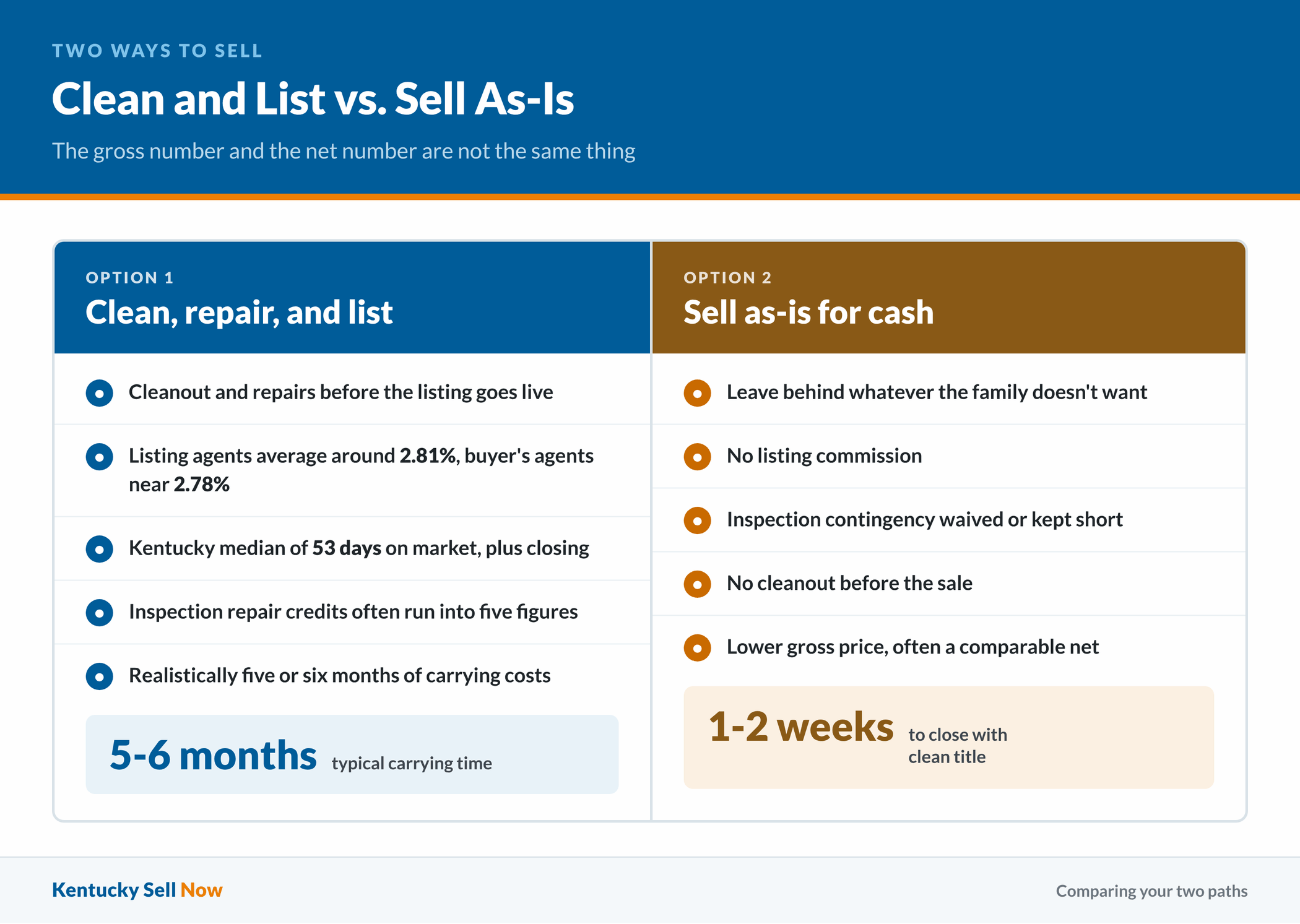
Cash buyers who specialize in a hoarder house in Kentucky usually waive inspection contingencies or keep them short. That’s the trade: you give up some price, you gain certainty and speed.
Something worth knowing about how we operate. When I buy a packed house, I’m pricing the cleanout, the unknowns behind the walls, and a margin for the surprises. Sellers who leave everything behind usually net about the same as sellers who spend three weekends hauling, because the haul doesn’t change my renovation scope much.
Kentucky Sell Now handles as-is purchases across the Commonwealth, and they’ll walk a hoarder house without asking you to tidy up first. That matters more to people than you’d guess.
Once you hand over keys, the new owner of that Kentucky property owns whatever remains inside.
How Much Does It Cost to Clean Up a Hoarder House in Kentucky?
“A couple thousand and a dumpster, right?” That’s what nearly everyone guesses, and for a mildly cluttered house it’s close. National cost data puts standard hoarding cleanup at roughly $1 to $2 per square foot, or $1,000 to $4,000 total, with crews sometimes billing $25 to $100 an hour instead.
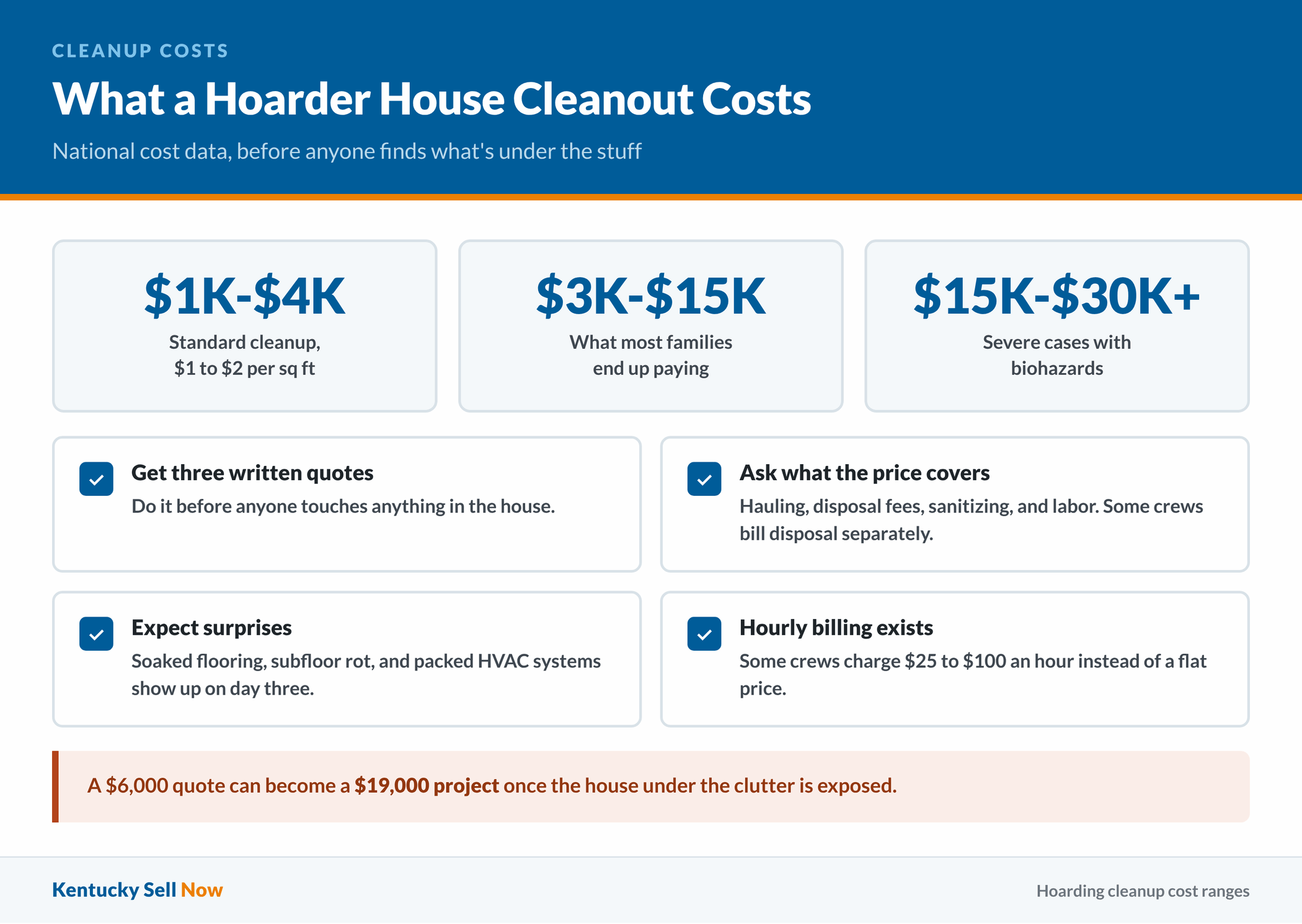
Most families end up paying somewhere between $3,000 and $15,000, and severe cases involving biohazards climb to $15,000 through $30,000 or beyond. Add animal waste, a failed septic line, or a deceased-occupant situation and specialty certification gets involved.
Kentucky labor runs below coastal rates, which helps. County transfer station tipping fees, tire disposal charges, and appliance recycling rules differ across Kentucky counties, so your local solid waste office is the right call for current rates.
A detail that wrecks budgets: the house under the stuff. Flooring soaked by decades of leaks, subfloor rot, and HVAC systems packed solid with debris only reveal themselves on day three of a cleanout. So your $6,000 quote becomes a $19,000 project, and now you’re a general contractor instead of a seller.
Get three written quotes before anyone touches anything. Ask whether the price includes hauling, disposal fees, sanitizing, and labor, because some Kentucky crews quote labor alone and bill disposal separately afterward.
Habitat ReStores in Louisville, Lexington, and Northern Kentucky accept usable furniture and fixtures, and a documented donation may carry tax value worth asking your accountant about.
What Are the Costs of Selling a Hoarder House in Kentucky?
“After everything, what do I walk away with?”
Fair question. The answer depends heavily on which path you take. Listing a Kentucky house traditionally means commission, and Kentucky listing agents average around 2.81 percent with buyer’s agents near 2.78 percent. Combined, that’s most of your closing cost right there.
Rates are negotiable in Kentucky, always have been, and a difficult property gives you less leverage but not zero.
Beyond commission you’ve got a deed preparation fee, recording charges at the county clerk’s office, and your prorated share of property taxes. Northern Kentucky closings sometimes handle transfer fees differently than Western Kentucky ones, so ask your closing attorney for a line-item estimate early rather than at the table.
Then there’s the hidden cost nobody puts on a settlement statement: carrying time. Kentucky’s median days on market hit 53 in October 2026, eight days longer than a year earlier. Add closing time on top of that. A hoarder house in Kentucky needs cleanout and repairs before it even starts those 53 days ticking, so realistically you’re carrying the place five or six months.
Inspection findings on a formerly hoarded Kentucky home generate repair credit requests that routinely run into five figures, and those come straight off your proceeds.
You’ll see a lower gross number and often a comparable or better net number, which is the only number that pays your bills.
What Steps Are Involved in Selling a Hoarder House in Kentucky?
Skip the title work and you’ll discover an unreleased lien from 1998 the week you’re supposed to close. It happens constantly with inherited Kentucky property, and it adds thirty to sixty days.
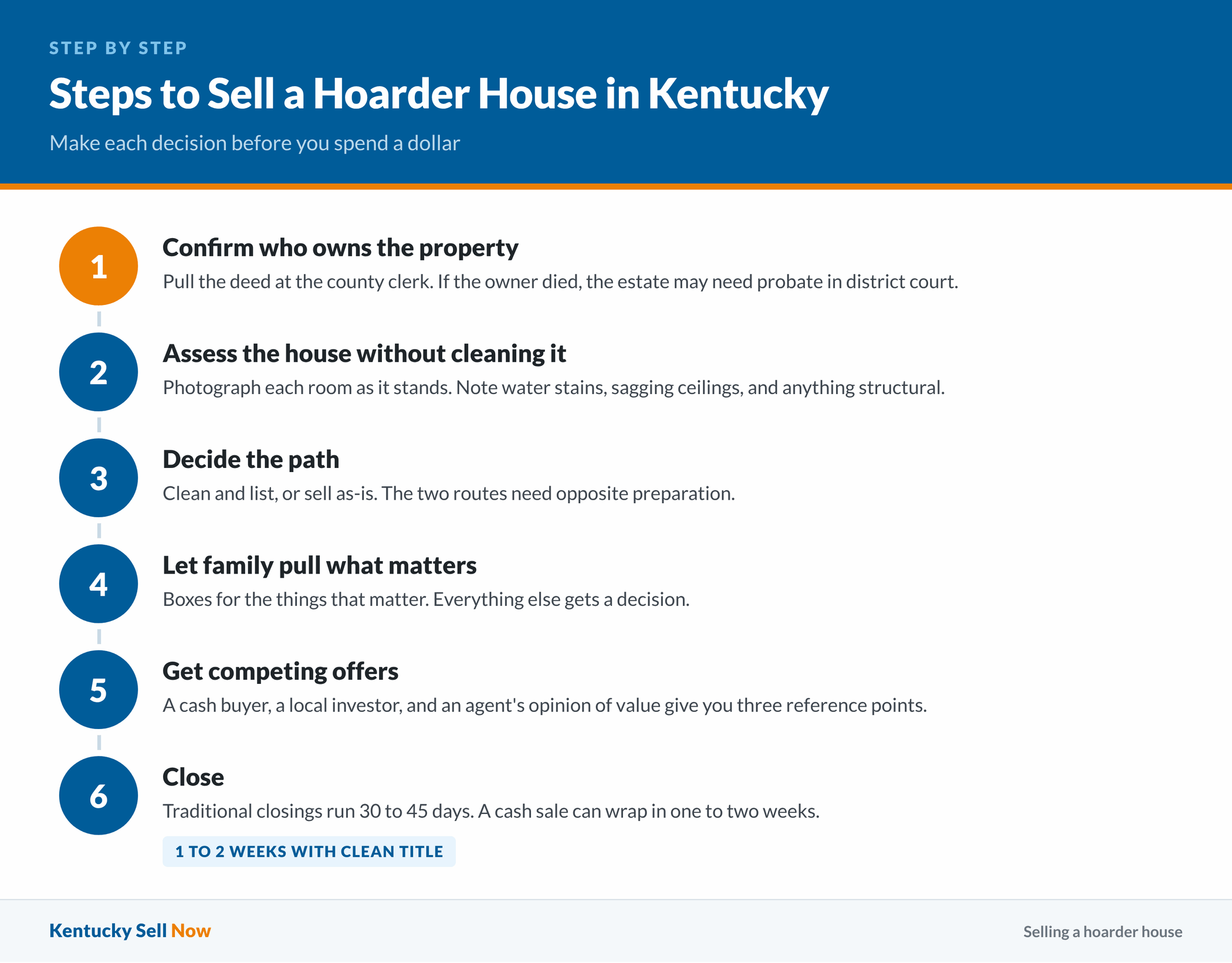
Confirm who actually owns the property. Pull the deed at the county clerk’s office and confirm exactly whose name holds title. If the owner died, the estate may need to pass through probate in the Kentucky district court for that county before anyone can convey clear title.
Second, assess the hoarder house without cleaning it. Photograph each room as it stands. Note water stains, sagging ceilings, and anything structural. You’re building a condition record that supports honest disclosure later.
Third, decide the path: clean and list, or sell as-is. Make that call before spending a dollar, because the two routes require opposite preparation.
Family members walk the house with boxes for the things that matter, and everything else gets a decision. This is the step that takes months, and the mortgage servicer doesn’t pause while siblings debate a china cabinet.
Fifth, get competing offers. A Kentucky cash buyer, a local investor, and an agent’s opinion of value give you three reference points. Any buyer who pressures you to decide on the spot isn’t someone to work with.
Last, close. A traditional Kentucky closing runs 30 to 45 days once you’re under contract. A cash purchase on a hoarder house in Kentucky can wrap in one to two weeks when the title’s clean.
How Do You Find Buyers for a Hoarder House in Kentucky?
Your buyer for this house is not the young couple from Crestwood with an FHA pre-approval. I say that early in every conversation, because chasing the wrong buyer costs people a full season.
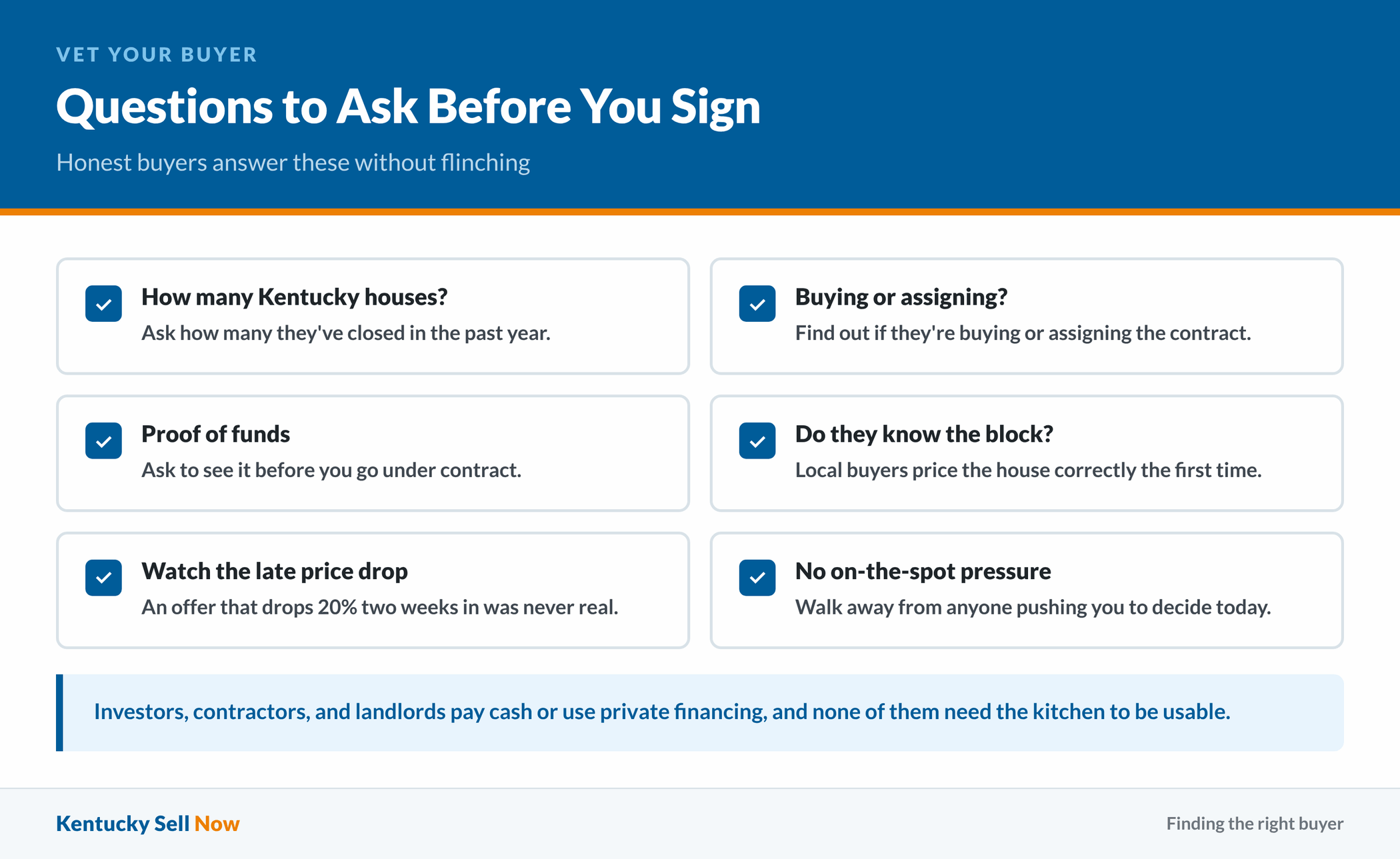
Investors buy a hoarder house in Kentucky. So do contractors looking for a project, landlords building rental portfolios in Bowling Green or Paducah, and occasionally a neighbor who’s wanted the lot for years. All of them pay cash or use private financing, and none of them need the kitchen to be usable.
Local knowledge matters more here than in a normal sale. A buyer who knows the difference between a Germantown shotgun and a Shelby Park foursquare prices your Kentucky house correctly the first time. Out-of-state wholesalers who’ve never driven the block tend to make a high offer. They then renegotiate after “their inspector” visits.
Watch for that pattern. An offer that drops twenty percent two weeks in was never a real offer.
Vet whoever you talk to. Ask how many Kentucky houses they’ve closed in the past year, ask whether they’re buying or assigning the contract, and ask for proof of funds. Honest buyers answer those three questions without flinching.
Companies like Kentucky Sell Now get called on these properties specifically because they close without the cleanout contingency that trips up retail buyers. If you’d rather talk to someone who’s seen worse than your house, that’s the category to call.
Probate attorneys and estate liquidators in Kentucky also maintain buyer lists. Your lawyer may know three people who’d write an offer this week on a hoarder house in Kentucky without ever seeing an MLS listing.
What Should You Do with a Hoarder’s Home in Kentucky?
For years I pushed families to clean before selling, thinking I was saving them money. I was wrong about that more often than I was right.
What I’ve learned is that the cleanout almost never pays for itself on a true hoarder house in Kentucky. Buyers who want packed houses don’t discount for a sweep. Buyers who want clean houses want new flooring, fresh paint, and a working HVAC too, so a swept hoarder house still doesn’t qualify.
Separate the decisions instead. Family retrieves what’s meaningful: photographs, documents, the one piece of furniture that matters. Everything else transfers with the Kentucky property or goes to donation.
Guard the paperwork. Deeds, insurance policies, and savings bonds hide in hoarded homes constantly, tucked into books and coat pockets. I’ve watched crews find bearer bonds in a freezer in Henderson.
There’s also the human piece. Hoarding disorder is a recognized mental health condition, and pressuring an aging parent into a forced cleanout damages relationships that outlast the real estate. The International OCD Foundation maintains resources for families and clinicians, and Kentucky has therapists who specialize in it.
A seller in Bardstown had been quietly paying two mortgages for close to a year, his own and his late mother’s, without telling his wife the second one existed. The mother’s house still had her sewing room intact, machine threaded, fabric stacked to the window. He didn’t want a fortune for it; he wanted to stop writing that check every month, and we closed in nineteen days.
Frequently Asked Questions
What’s the Best Way to Sell a Hoarder House?
Pick your buyer type first, then prepare accordingly. If you’re selling as-is to a cash buyer or investor, do nothing beyond removing what your family wants to keep and documenting the condition honestly. If you’re listing on the open market in Kentucky, budget for a full cleanout plus repairs and expect the process to take several months from first dumpster to closing table. Comparing at least one as-is offer against an agent’s valuation is the fastest way to see which route nets you more.
I Just Inherited a Hoarder House. Where Do I Start?
Confirm you actually have legal authority to sell before anything else, because an inherited Kentucky property often needs to clear probate in the district court of the county where the owner lived. While that’s pending, keep insurance active and utilities on so pipes don’t freeze. Walk the house with siblings early and agree in writing on who keeps what, since that conversation causes more delays than any legal step does. Only after those pieces are settled should you decide between cleaning or selling in current condition.
Do I Have to Tell Buyers About Mold or Pest Problems?
Yes, if you know about them. Kentucky’s disclosure rules turn on seller knowledge, so conditions you’re aware of belong on the form even when you’re selling a hoarder house in Kentucky with no repairs. Selling as-is protects you from having to fix anything; it doesn’t let you conceal what you’ve seen. Writing down the problems you know about is genuinely safer than leaving blanks.
Will Homeowners Insurance Cover a Hoarder House Cleanout?
Standard policies generally won’t pay to remove accumulated personal belongings, since that’s not a covered peril. Coverage sometimes applies when a specific event caused the damage, like a burst pipe or a sewer backup that contaminated the contents. Call your carrier before you hire anyone and ask what documentation they’d need. Mentioning that the home is vacant may trigger a policy review, so understand your coverage status first.
Can a Hoarder House in Kentucky Be Financed by a Regular Buyer?
Rarely. Conventional, FHA, and VA appraisers need access to the mechanical systems and habitable living space, and blocked rooms usually mean a failed appraisal or a repair-required condition. That’s why a hoarder house in Kentucky typically sells to cash buyers or renovation-loan borrowers. If you clean and repair it fully first, traditional financing opens back up, though that path takes months and real money.
How Fast Can I Sell If I Need Out Quickly?
Direct cash purchases on a hoarder house in Kentucky commonly close inside two weeks when title is clear and no probate is pending. Add time if the deed needs correcting, an estate has to be opened, or a lien shows up during the title search. Tell the buyer your deadline up front; a local one will usually tell you honestly whether it’s achievable.
Selling a Hoarder House in Louisville
Louisville is where we buy the most packed houses, and the local market gives sellers a cushion. Redfin’s mid-year market review put the Louisville median sale price at $281,984 for the first half of 2026, up 2.3% from a year earlier.
We buy houses in Louisville from Shively to Okolona, and a cluttered house there gets the same as-is offer as a clean one down the street would get after a cleanout.
Get an As-Is Offer on Your Hoarder House
If you’re sitting on a packed house and you’re tired of thinking about it, I’m glad to walk through what your options look like, including the ones that don’t involve selling to me. No pressure, no obligation, no cleanup required before I show up.
Fill out the short form below to get started, or keep reading through our other guides if you’re still weighing your options.
Sell Your House Fast in Louisville 💰
We buy houses in Louisville As-Is! No Hidden Fees or Real Estate Commissions. Sell Your House in Louisville And Close On The Date Of Your Choice. Simply Fill Out The Form, or call (502) 610-0070 today!