
A deed sat unrecorded in a Shelby Park kitchen drawer for nineteen years. The seller had paid cash, shaken hands, and moved in. When she tried to sell, the closing attorney found the property still sitting in a dead man’s name, and that’s when the conversation about title issues started.
I’ve bought houses all over Louisville, and the pattern repeats. Title issues don’t announce themselves. They surface three weeks into a contract, usually after you’ve already packed.
What Title Issues Could Delay Your Louisville Home Sale?
So what actually shows up on a Louisville title search that stops a closing cold?
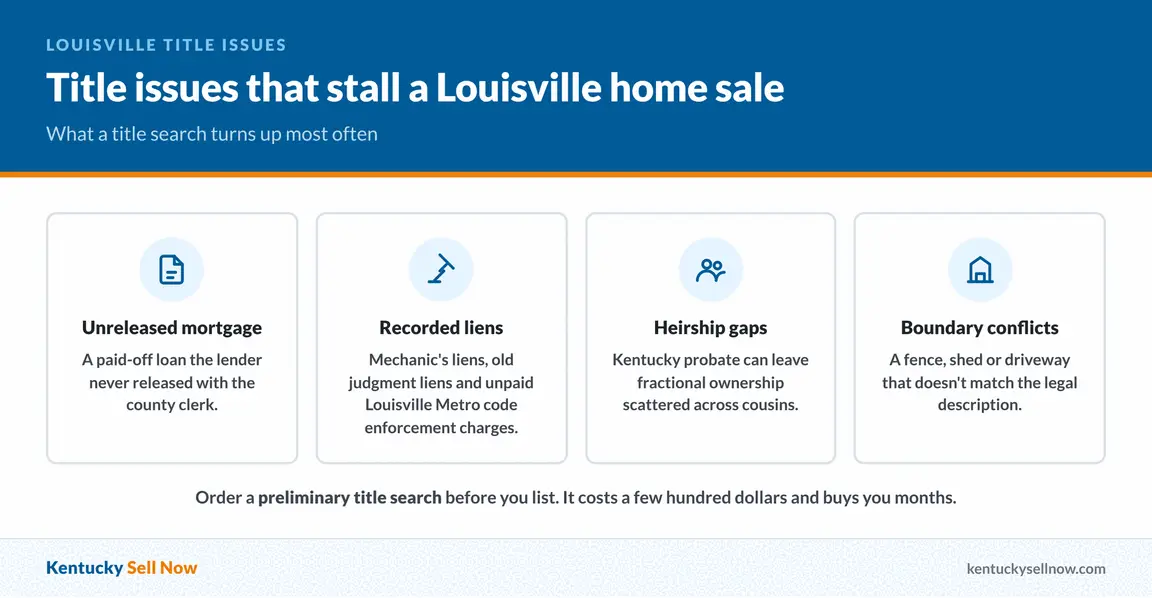
The most common culprit is an unreleased mortgage. A lender gets paid off, then never files the release with the county clerk, and the old loan sits on the record like a ghost. Kentucky probate leaves fractional ownership interests scattered across cousins, and a title company won’t insure around them.
Mechanic’s liens from a contractor who never got his final draw. Unpaid Louisville Metro code enforcement charges. Old judgment liens from a credit card suit in district court, any one of which can freeze your sale.
Timing makes title issues expensive here. Louisville homes took an average of 34 days on market in October 2026, up from 26 days the prior year, according to Garrett’s Realty market data. Add roughly five weeks from contract to closing and you’re already at two and a half months. Title issues can tack on another sixty days, and buyers with rate locks don’t wait that long.
I bought a small ranch in Okolona a couple of years ago from a young couple splitting assets in a divorce. Their title search turned up a lien from a roofing company that had worked on the detached garage years earlier, and neither of them remembered it even existed.
Sellers in Louisville often find out about title issues at the worst moment. Order a preliminary title search before you list. It costs a few hundred dollars and it buys you months.
Why Do Boundary Inconsistencies Cause Title Problems?
One seller in Germantown had a fence her grandfather built in the 1960s. The survey showed it standing four feet onto the neighbor’s lot, which meant her deed described one piece of land and her yard occupied another.
Older Louisville neighborhoods were platted before modern surveying, and the legal descriptions still reference things like stone markers and dead oak trees. Shotgun houses in Portland and Smoketown sit on narrow lots where a three-foot discrepancy swallows a driveway. Title companies flag these.
What creates the real title issues isn’t the fence itself. It’s what happens when the neighbor’s deed and yours both claim the same strip of dirt, because now two recorded documents contradict each other in the public record.
Have you ever looked at your actual legal description? Most Louisville homeowners haven’t, and the ones who do are usually surprised by how vague the language gets.
Encroachments run both directions. A fence or shed sitting on the wrong side of the line. A shared driveway in Clifton with no recorded easement. Neighbors in the Highlands who agreed decades ago to split a gravel alley and never put it in writing. Each of these turns into title issues the moment a title examiner reads the file.
Fixing boundary problems usually takes a new survey plus a corrective instrument, often a quitclaim deed from the neighbor releasing any claim, so cooperation matters a lot here. When the neighbor is agreeable, you can resolve it in a few weeks. When the neighbor smells leverage, the process stretches and the Jefferson County Circuit Court gets involved through a quiet title action. Kentucky allows that suit under KRS 411.120 for anyone holding both legal title and possession of the land.
Louisville buyers who are financing will not close over an unresolved encroachment. Cash buyers sometimes will.
How Do Vesting Deed Errors Affect Your Property Title?
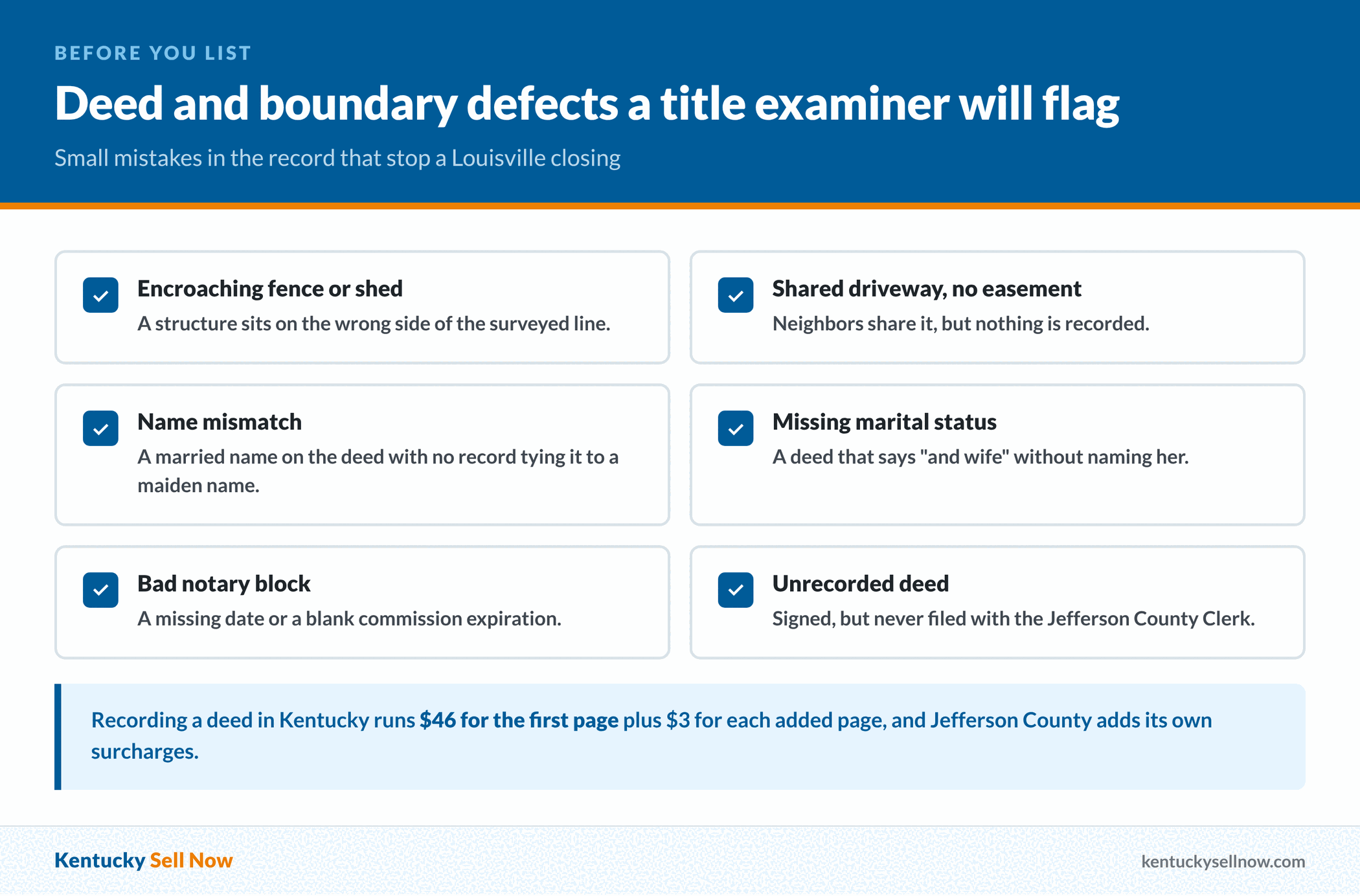
Before: a mother deeds her Fern Creek house to her daughter, writing the daughter’s married name on a form she downloaded. After: the daughter divorces, reverts to her maiden name, and no document in the Jefferson County record connects the two people, which means the chain of title just breaks.
Vesting language is where small mistakes grow teeth. A grantor’s name misspelled by one letter. A missing marital status. A deed that says “and wife” without naming her.
I’ve watched more closings stall over a bad notary block than over big, messy problems. The notary forgot a date, and the commission expiration was blank too. Those title issues are simple to fix and still take two weeks because you need the original signer back at a desk.
Joint tenancy language causes trouble too. If a deed fails to spell out survivorship rights the way Kentucky requires, a surviving co-owner may not own what everyone assumed.
Quitclaim deeds deserve a warning. People in Louisville use them constantly to move property between family members, and they’re cheap and fast. A quitclaim deed, though, transfers only whatever interest the grantor actually had, with no warranty attached. I’d rather see a general warranty deed in any transfer that matters.
You must record the contract as carefully as you draft it. A deed signed and never filed with the Jefferson County Clerk’s office at 527 West Jefferson Street doesn’t give the world notice, and the title examiner searching Louisville land records will never see it. Kentucky’s deed recording fee runs $46 for the first page plus $3 for each additional page under KRS 64.012, per the statewide clerk fee schedule, though Jefferson County adds its own surcharges. Cheap insurance against a decade of title issues.
What Happens with Incomplete Mortgage Assignments on a Title?
And that recording problem gets worse when loans change hands. Your Louisville mortgage was probably sold two or three times. Each transfer should generate a recorded assignment showing who holds the note now.
Frequently it doesn’t.
Servicers merge, and banks go under. A lender from 2008 no longer exists, and the entity that absorbed its portfolio never bothered to record the paperwork in Jefferson County. Years later you pay off the loan and nobody files a release, because the company that should sign it is gone. Your title search shows an open mortgage with no living creditor.
Title companies hate this. They can’t insure a Louisville property with a dangling encumbrance, so they chase down successor entities, request payoff letters, and sometimes order a lost-instrument bond. Three to eight weeks is typical.
Home equity lines create their own version. A HELOC gets paid to zero but never closed, so the lien stays recorded against your Louisville house even though the balance is nothing.
What should you do right now if you suspect a gap? Start by pulling your own property record. The Jefferson County Clerk keeps an online land records index of recorded deeds, mortgages and releases. You can also inspect the originals in person at the Recording Division for free, according to a Jefferson County records guide. An hour of searching tells you whether title issues are waiting.
Kentucky Sell Now handles these gaps regularly on the Louisville houses it buys, which matters because an investor who’s already worked through a missing assignment knows which affidavit the title company will accept.
Canceled checks, payoff statements, email confirmations from the servicer. That file is what resolves title issues when the recorded trail fails you.
Can Recorded Liens Stop You From Selling in Louisville, KY?
Plenty of Louisville sellers believe a lien means the sale is dead. It doesn’t. Liens get paid from closing proceeds every single day in Jefferson County, and the title company handles the disbursement.
Judgment liens follow specific rules. Kentucky’s House Bill 83 revised KRS 426.720 in 2023, cutting the initial life of a judgment lien from fifteen years to ten, with a single renewal available to the creditor. The statute itself spells out the filing and notice requirements and is posted by the Legislative Research Commission. An older judgment lien clouding your Louisville title may already be unenforceable, which your attorney can check against the court file.
Homeowners association liens are common in Louisville subdivisions like Hurstbourne and Lake Forest. They’re usually small, often disputed, and almost always resolvable with a phone call and a payoff figure.
I’ll defend this stance: paying a questionable lien just to close is frequently the right call. Sellers get righteous about a $900 charge they don’t believe they owe, then spend $3,000 in legal fees and four months proving it. Do the arithmetic before you plant a flag.
Sellers in Louisville with real equity have leverage. Lienholders accept discounts, especially on old debt, and a title company or attorney can negotiate the release in writing before closing.
Statewide context helps you read your own position: Kentucky’s median sale price reached $278,832 in October 2026, up 1.4 percent year over year, according to Redfin’s state market data. Equity is the cushion that makes most title issues solvable instead of fatal.
What Are Your Options for Selling a House with Title Issues in Louisville?
Pick the wrong path and you lose a buyer, your earnest money deposit evaporates into attorney fees, and your Louisville house goes back on the market with a stale listing date that invites lowballs. That’s the cost of guessing.
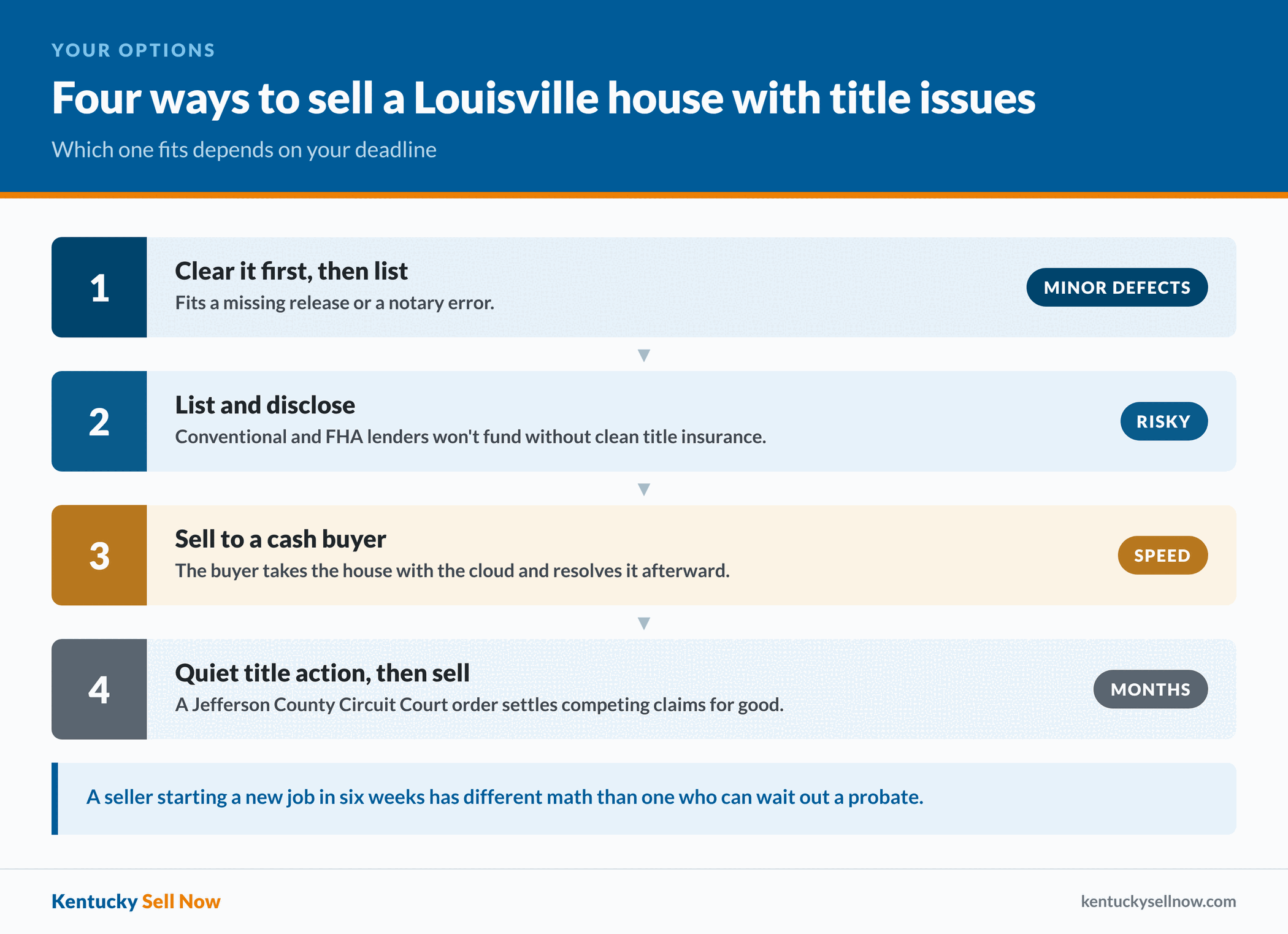
Option one: clear the title issues first, then list traditionally. A missing release or a notary error fits here.
The second option: list and disclose, hoping a buyer accepts the risk. I’m skeptical of this. Buyers in Louisville using conventional or FHA financing can’t close over unresolved title issues, because their lender won’t fund without clean title insurance.
Option three: sell to a cash buyer who takes the property with the cloud intact and resolves it afterward. You take a lower price in exchange for certainty and speed.
Fourth option: a quiet title action in Jefferson County Circuit Court, then sell. This is the heavy tool. Expect months, filing costs, and attorney time, but it produces a court order that permanently settles competing claims.
Which one fits depends on your deadline. A Louisville seller with a job starting in Nashville in six weeks has different math than one who can wait out a probate.
Kentucky Sell Now buys Louisville properties with unresolved title issues directly, and you can walk through your specific situation at kentuckysellnow.com without committing to anything. If your defect is genuinely minor though, I’d still point you toward fixing it and listing, since the open market will pay more.
Who Can Help You Resolve Title Issues Before Closing?
For years I assumed a title company and a real estate attorney did roughly the same job, and that assumption cost one of my early Louisville closings about three weeks.
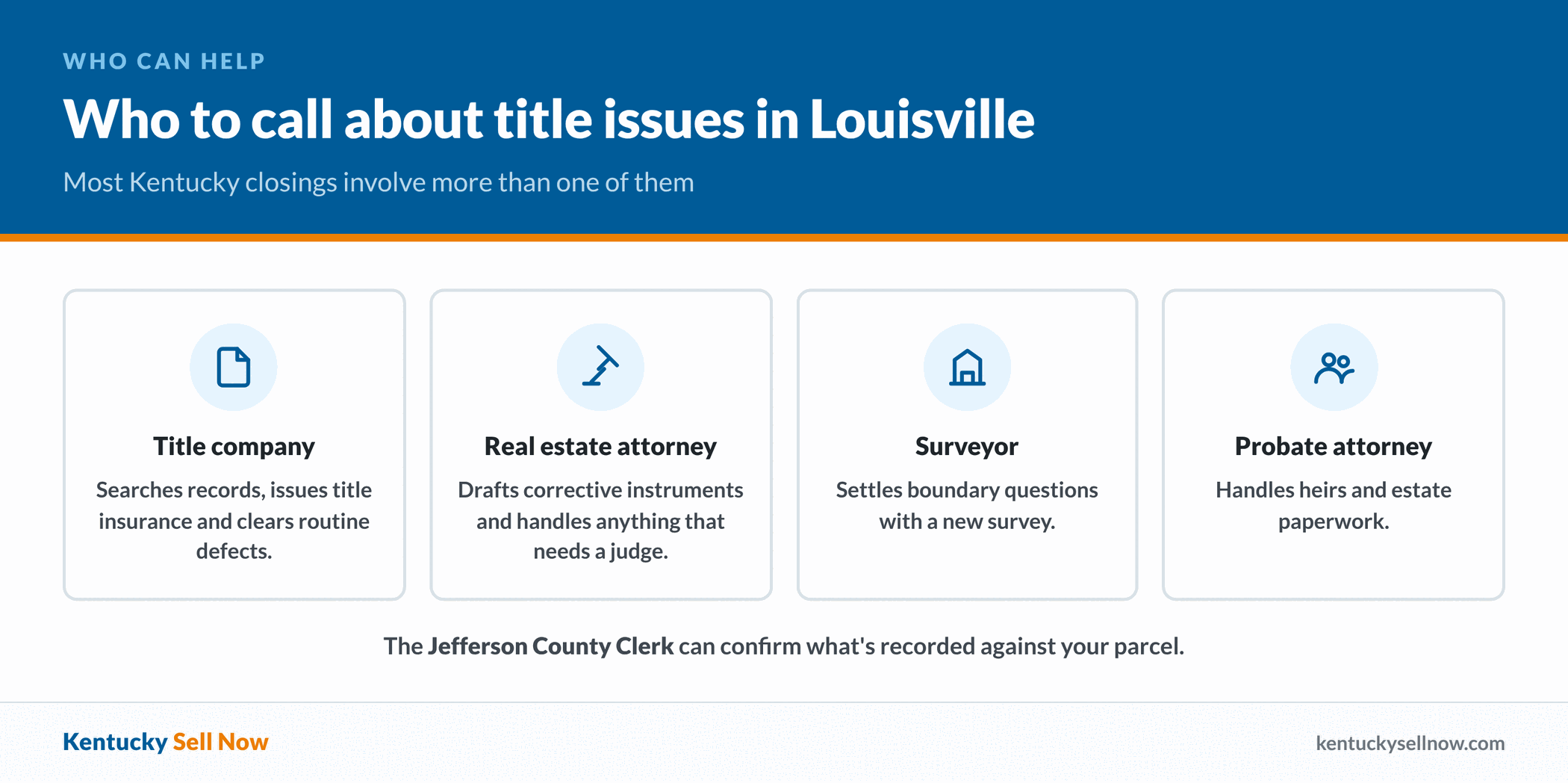
Title companies search records, issue title insurance, and clear routine defects. They’re transactional. Attorneys litigate, draft corrective instruments, and handle anything requiring a judge, so in Kentucky, most residential closings involve both, and knowing who to call first saves real time.
Your title insurance policy is the document that protects a Louisville buyer from defects nobody found. Lender policies protect the bank only. Owner’s policies protect the owner, cost a one-time premium at closing, and last as long as you hold the property. Buy one.
Surveyors resolve boundary title issues. Probate attorneys handle heirs. The Jefferson County Clerk’s Legal Records Division can confirm what’s recorded against your parcel, and a closing attorney coordinates all of it.
Experienced Louisville investors belong on this list too. We’ve seen most title issues before and know which ones are genuinely hard versus merely annoying.
One woman in Valley Station called me about her father’s house after he passed. Thirty years of belongings filled every room, including a garage stacked with coffee cans of sorted hardware. Her two brothers in other states just wanted a clean exit without flying back for a cleanout. We bought it with the estate paperwork still pending, worked through the heirship documents with her attorney, and she kept one box of photographs.
Frequently Asked Questions
How Long Does It Take to Clear Title Issues in Louisville?
That comes down to what the title search turns up. A missing release or a notary error usually clears once the right person signs a corrected document and the clerk records it. A boundary dispute or a contested heirship can stretch for months, because neighbors and heirs have to agree, or a judge has to decide for them. If you’re working against a move date, ask your closing attorney for a realistic timeline before you sign a listing agreement. Their answer tells you which path makes sense for your house.
Will Title Issues Show Up on My Own Record Search?
Usually yes, if you know where to look. The Jefferson County Clerk’s online land records index will show recorded deeds, mortgages, releases, and lien notices tied to your parcel in Louisville. A homeowner search won’t reliably catch unrecorded heirship, a defective legal description or a notary defect buried in an old instrument. That’s why a professional title search still matters before you list.
Can I Sell a Louisville House That’s Still in a Deceased Parent’s Name?
You can, but not by yourself and not instantly. Kentucky requires the estate to pass through probate or an equivalent process so that ownership interests transfer legally to the heirs, and every heir with an interest typically has to sign. Some Louisville investors will contract with you while probate is pending and close once the court signs off, which keeps the property moving instead of sitting empty for a year.
Does Title Insurance Fix Title Issues That Already Exist?
Not exactly. A policy protects against defects that weren’t discovered during the search, so it covers the unknown rather than the known. If a title company already flagged a problem on your Louisville property, it’ll usually take exception to it in the policy and require it cleared before closing. So the fix comes first and the insurance comes after.
How Much Do Title Issues Reduce What I Can Sell For?
It depends entirely on whether the defect is curable and who’s buying. A missing release that costs a few hundred dollars to resolve barely moves your Louisville sale price. A disputed boundary or a contested heirship can take a real bite, because any buyer absorbing that risk prices in both the legal cost and the uncertainty of the timeline.
Should I Tell Buyers About Title Issues Up Front?
Yes, and I’d argue it’s in your own interest. Louisville buyers who learn about a cloud three weeks into escrow walk away and tell their agent why, and that story follows your listing. Disclosing early filters out buyers who were never going to close and draws the ones who can handle the situation.
Is a Quiet Title Action Worth the Time and Cost?
Sometimes it’s the only path, particularly when a competing claim has no other resolution and the property has enough value to justify it. Filing in Jefferson County Circuit Court takes months and real money, so the calculation depends on your equity and your deadline. If you need out faster than a court docket moves, selling to a buyer willing to inherit the fight is a legitimate alternative.
If you’re sitting on a Louisville house with something tangled in the title and you’re not sure what it’s going to cost you, we’re happy to talk it through. No pressure, no obligation, and if the smarter move is fixing the problem and listing on the open market, I’ll tell you that too.
What Louisville’s Market Means for a Clouded Title
Louisville buyers have more homes to pick from this year. Active listings across the metro rose 20.5 percent in the first half of 2026, based on Redfin’s mid-year market review. With that many choices, a financed buyer can pass on a house with title issues and move on to the next one.
That’s where a direct sale can help. Kentucky Sell Now buys houses with title problems in Louisville and across the state. If you’re east of the city, we buy houses in Shelbyville too.
Talk With Kentucky Sell Now About Your Title Problem
Title issues come in all sizes, and some take longer to sort out than others. If you’d like a cash offer on your Louisville house as it sits, reach out to Kentucky Sell Now and tell us what the title search turned up. You can also fill out the form below. There’s no cost and no obligation to ask.